

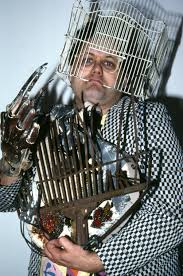
 The Boogie Banjoist values musicians who pave there own path. People who make creative choices, eclectic individuals who are not bound by the public perceptions of our instrument. You will have a tough time finding a more eclectic musician than Eugene Chadbourne (aka Doc Chad). His songwriting is both clever and poignant, his improvised music can range from hauntingly beautiful to noisy and cathardic. His covers are respectful renditions that are also pleasently peculiar. Collaborations range from rock bands to jazz musicians, a list that would be longer than this measly article about him. Eugene has been a guitar player from the start, but he picked up banjo and has been including it consistently in his recordings and performances ever since. He is an inventor of instruments, who famously created the electric rake and other odd instruments made of broken guitars, some of which were displayed recently in his home museum exhibition along with his other outsider art pieces.
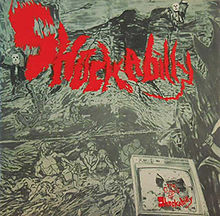
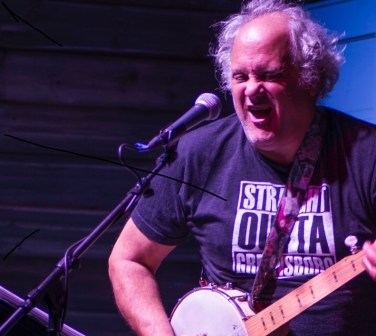 Eugene currently lives in Greensboro NC, but lived in New York City for many years in the 1980’s, and was part of the downtown scene of avant-garde improvisors. During his time in New York, he started playing country-western music in his band Shockabilly. There aren’t many examples of this blend of avant-garde, jazz, punk, with country music. Doc Chad sort of cornered the market on that.
His singing voice is part Bugs Bunny, part Hank Williams. Imbibed with sincere emotion and an endless sense of humor. It’s hard not to draw connections to Frank Zappa, who combined intellect, musical complexity, and comedic novelty in a natural way that is just an individual’s artistic expression. Drummer from Zappa’s original band the Mothers, Jimmy Carl Black, recorded and toured with Eugene as “The Jack and Jim Show.”
Folk protest and political songs of the 60’s and 70’s are another influence of Eugene’s. Many of his original songs contain political statements. For example, in 2001 right after the U.S. declare a “war on terror,” he released the song “New New New, War War War.” It’s a jazzy folk protest song filled with true statements and free-wheeling guitar runs.
Here’s a great song he wrote called “Dirt,” recorded on a balcony in St. Petersburg Russia.
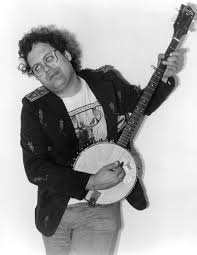
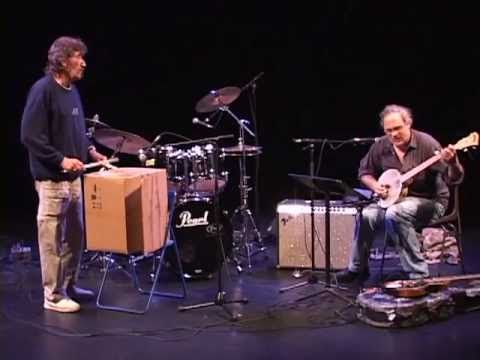
Eugene plays banjo in his own unique way. He uses fingerpicks, but is not restricted to “bluegrass” style. The above video shows him using his thumb pick for a tremolo effect for example. Sometimes he employs a small half slide on one finger. He is always keeping things a little loose and spontaneuos making it interesting for him and the audience. He plays his originals, country, folk, jazz, and hip-hop/R&B songs including at least two different TLC covers!
Boogie Banjo’s own Windy Boijen helped organize Eugene’s visit to Phoenix, AZ on Dec 2nd, 2018. Leading up to the show we had the chance to ask the good doctor some questions about banjos, and banjo related topics.
BB – Can you remember the first time you heard a banjo, or found out about the instrument?
EC – Yes clearly, when my 8th grade girlfriend Kandi and I went to see Arthur Penn’s Bonnie and Clyde in Hollywood.
BB – Was there a time where you heard a banjo player who changed your perception of the instrument??
EC – Not really because I have always had a perception that the banjo has limitless capabilities.
BB – You did some shows doing Bach on banjo. Can you tell me about that project?
EC – I had the violin sonatas and partitas scores around for sightreading practice on the guitar, then started fooling around with on the banjo. There was a lot of transposition involved not so much in keys but in where to fret all the notes that were lower than the banjo’s range; a kind of simplistic innovation was taking any “G” pitch, no matter where it was staffed, and play that on the 5th ‘drone’ string. This sometimes ended up sounding like Bach harpsichord music. I ended up recording some of the pieces for a small Western Canadian firm, Volataile. That is long out of business but the former owner keeps finding boxes of this CD which was entitled “German Country and Western Music” around his house. It wasn’t like doing this created a tidal wave of positive reactions but over the years I kept gettting compliments about these interpretations, several years ago I was invited to do a new Bach banjo product, they suggested something based on the Goldberg Variations, this for one of the most prestigous festivals of avant garde music on the planet, held annually in Donaueschingen, Germany I decided to do this with the fretless banjo I had made for me by Deering. The performances took place in a building that had been used as a prisoner of war camp during World War II.
BB – I always see you playing a goodtime banjo….
EC – Before they made the Goodtime, I owned a couple of really horrible cheap banjos that didn’t play in tune, then a somewhat better East German banjo I purchased in Leipzig, this actually played in tune all the way up the neck. Before I had the Goodtime I bought a used Deering Deluxe from a private individual. I met Janet Deering at the Tennessee Banjo Institute and have gotten involved as someone who is offered various new models at a discount in order to try them out and comment. Besides the fretless I also own one I really like that has a slightly larger hoop, I will have that one out in Arizona. I also own a vintage 5-string made by the Royal company out of Chicago. I still have the original Goodtime, recently refurbished, and two of my daughters also own them.
In general I think the Goodtimes play really well, in tune, and are sturdy and easy to repair.
BB – How do you decide if you’re going to play banjo on a song, as opposed to a guitar?
EC – Instinct but I switch back and forth. The most obvious thing might be the chord changes, do I need a strong bass line, are the chords too complicated to ring out on the banjo in any sensible fashion. Covers of rap or soul songs almost always are handed off to the banjo because of the strong audience reaction to the entire idea. Recently some Phil Ochs material I have played for years I am trying out on banjo because the big hoop Goodtime “Americana” (don’t like the name!!) provides the proper bass presence.
BB – Have you ever experienced any “discrimination” as a banjo player in the jazz or rock scenes?
EC – No, the opposite, but I get discriminated against for playing country and western.
BB – You moved to Greensboro, NC. Was that decision influenced by the prevalence of banjo music, or the culture of that area?
EC – More important factors were cheaper living expenses, more personal space and (at that time, not any longer my country band could play three or four nights each week within a 100 mile radius.
BB – Has living there been an influence on your life or music?
EC – Well anywhere anyone lives would influence their life. I sensed it would be easier and more family friendly to base my operations out of Greensboro. Other than being unemployed too much I have done exactly what I want to do with music.
BB – Frank Zappa once said (something like) “I’m a composer who’s instrument happens to be electric guitar.” Would you classify yourself similarly or something else?
EC – I am not sure exactly what he is talking about, usually, because there has never really been a reason to identify composers with specific instruments, although most of them have played one or more instruments, and some composers certainly play electric guitar. I classify myself as part of the worldwide musical community.
BB – Can you describe or categorize your style/approach to the banjo? Did you first learn as a student of banjo, or as a musician discovering how the instrument could work for you?
EC – I already knew how to play the guitar and Tony Trischka told me that immediately meant I would approach playing chords on the banjo differently, I would shift over all the guitar knowledge. But when I started banjo I had to start with one tuning and learn some relatively simple songs, yet even in this context I was backing up myself up as a singer in a solo context, whereas banjoists are more often heard as members of an ensemble than unaccompanied.
BB – Have you had issues labeling your music as a certain genre?
EC – I don’t know how you would do it and there are lots of other musicians who are the same way, in Germany they have an expression that is something I like “I sit on more than one chair.”
BB – Pretty much all your music is available to order directly through you, which is amazing. It’s fun to look through all your stuff, the variety, the collaborations, etc. You often play with people in the “free improv” scene, so I was delighted and surprised to see a recording of you and Tony Trishka. Can you tell me about your collaboration with him?
EC – We figured out a week we could go on the road together because I had some decent offers from Madison, Kansas City, Chicago, St. Louis. We spent a lot of time teaching each other stuff, he taught me the D tuning and Reuben’s Train and I taught him some Charlie Parker and Thelonious Monk tunes. Later he got me into the Tennessee Banjo Institute. He has come to play with me a few times in New York City.
For a good time, go to Eugene’s website House of Chadula, where you can look at his musical timeline, and buy all the merchandise directly from the artist himself.
 The Boogie Banjo Blog - Roots, blues, jazz, traditional, experimental folk banjoists